This is a repeating event- Event 1 / 1021 January 2027 6:30 pm
Bleak House - Charles Dickens
Event Details
With Bleak House, Charles Dickens sharpened his satire to its finest point and never looked back. First published in monthly parts between 1852 and 1853, it is Gothic in atmosphere, labyrinthine in structure, and merciless in its central argument: that institutions designed to dispense justice can, given sufficient time and indifference, become engines of pure destruction.
At the heart of the novel sits Jarndyce and Jarndyce, a suit in Chancery — the English court of equity — that has been grinding through the system for so long that no living person can remember what it was originally about. It concerns an inheritance. Or several inheritances. Or possibly none at all. By the time we encounter it, the case has consumed fortunes, ruined lives, and become its own self-perpetuating institution: a monument to procedural delay so vast and so perfectly constructed that it requires no villain to sustain it. The system does that work entirely on its own.
Around this vortex, Dickens assembles one of the largest casts in English fiction. There is Esther Summerson, our narrator for half the novel — orphaned, self-effacing, unreliable in ways she cannot see, and, it is hard not to notice, rather more interested in Ada Clare than in any of the men who pursue her. There is Lady Dedlock, magnificent and glacial, with a secret that will undo her. There is Tulkinghorn, the family solicitor, a man who collects other people’s secrets the way other men collect art. There is Inspector Bucket, one of the first detectives in English literature, pursuing a truth that will satisfy no one. And there is Jo, the crossing-sweeper: a child who cannot read, does not know where he was born, and is moved on by every authority he encounters until there is nowhere left to move him.
The fog that opens the novel is Chancery made weather. Dickens’ critics considered the novel’s famous use of spontaneous combustion preposterous. He considered it a defensible metaphor. Both were right.
At a moment when courts are being asked to hold the line against executive power — and when the question of whether they can is genuinely open — Dickens’ portrait of a legal system that defeats justice through its own internal logic has never felt more urgent. Bleak House understands, with absolute clarity, how a system staffed by reasonable individuals and governed by elaborate rules can produce outcomes that are neither reasonable nor just. It understands how delay functions as a weapon. It understands how the people with the least recourse are the most reliably destroyed.
Dickens knew that the cruellest thing a corrupt system can do is not to break its own rules. It’s to follow them perfectly.
Let us read.
JOINING DETAILS:
- Ten-meeting study, live on Zoom, led by Dr Nancy Goldstein
- 14 January – 18 March 2027
- Thursdays, 6.30–8.30 pm (UK time)
- £400 for ten two-hour meetings
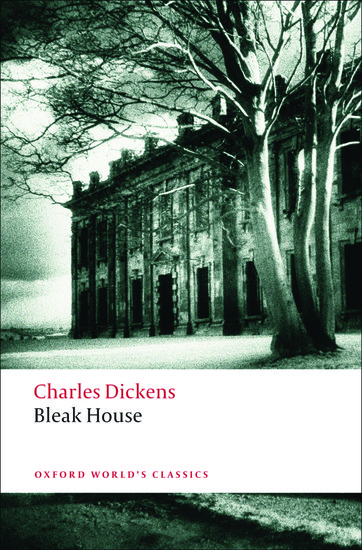
- Recommended edition: Bleak House, Oxford World’s Classics, edited with an introduction and notes by Stephen Gill, ISBN: 9780199536313.
REDUCED COSTS: we are committed to making our studies as affordable as possible. We have a fund in place to support anyone who would like to register for a study but finds the cost difficult to afford. We can’t promise to help, but please email us at litsalon@gmail.com in confidence if you would like to request a reduction in the cost of a study.