Virginia Woolf in Alfriston 2026! Study 1 - Flush & Freshwater
Event Details
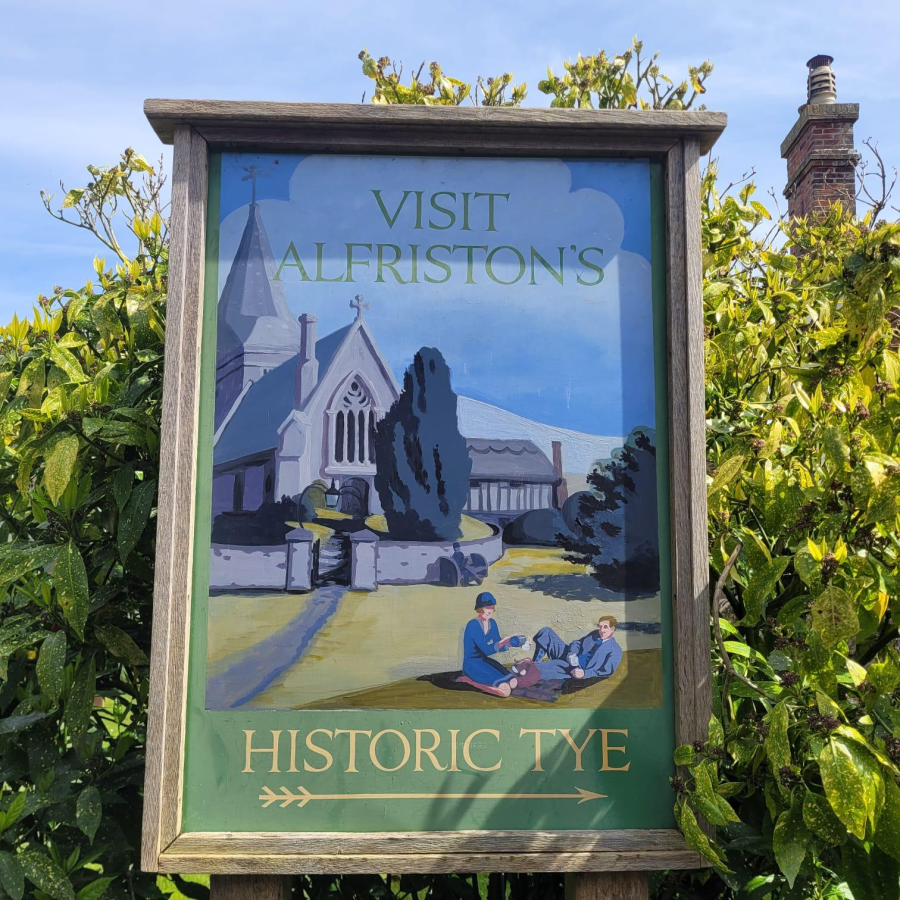
This will be our fourth year offering opportunities to read Virginia Woolf in East Sussex, a county which in many ways became the writer’s spiritual home and where we can consider her work surrounded by some of the countryside she loved best. In 2026 we will have two long weekend studies in Alfriston, the first (9-12 April) focusing on her 1933 ‘biography’ of Elizabeth Barrett Browning’s cocker spaniel Flush, together with her only play, Freshwater (1935); the second (16-19 April) exploring her 1941 novel Between the Acts.
Woolf is often viewed as a London writer, but much of her time was spent at her countryside home in the depths of the South Downs. It is difficult to overstate the importance of this landscape to her writing. Freshwater was first performed at Vanessa Bell’s London studio in Fitzroy Square, but it built on the playacting tradition that began at Bell’s countryside home, Charleston in Sussex. Similarly, Flush owes itself to a hybrid of urban and rural experiences, containing some of Woolf’s best reflections on what it means to escape the horrors of city life. While London has greatly changed since the 1930s, Alfriston still looks much as it did in Woolf’s time. Being there makes it possible to imagine a world where Lytton Strachey could be spotted on the high street and Duncan Grant might appear at the pub. To help aid this imaginative process there will be opportunities to visit relevant heritage sites including Monk’s House (the house near Rodmell that the Woolfs purchased in 1919 and used as their rural retreat) and Charleston Farmhouse.
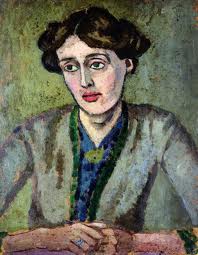
Virginia Woolf’s life writing is one of her greatest legacies, although some examples are better known than others. While many readers will know of her biography of Roger Fry, far fewer will have read the satirical comedy Freshwater with its raucous portrayal of 19th century celebrities, and although Orlando is a famous the world over, Woolf’s remarkable life story of a cocker spaniel named Flush is rarely studied at length. This salon allows readers to indulge in these two wonderful works, with a slow reading of Flush taking place over three days and an afternoon on Freshwater which will include a live performance devised by attendees.
“Spaniels are by nature sympathetic; Flush, as his story proves, had an even excessive appreciation of human emotions. The sight of his dear mistress snuffing the fresh air at last, letting it ruffle her white hair and redden the natural freshness of her face, while the lines on her huge brow smoothed themselves out, excited him to gambols whose wildness was half sympathy with her own delight.”
Virginia Woolf, Flush
Photograph of Karina Jakubowicz with Toby’s spaniel, Scout, at Alfriston in 2025, shown by kind permission of Janet Minichiello

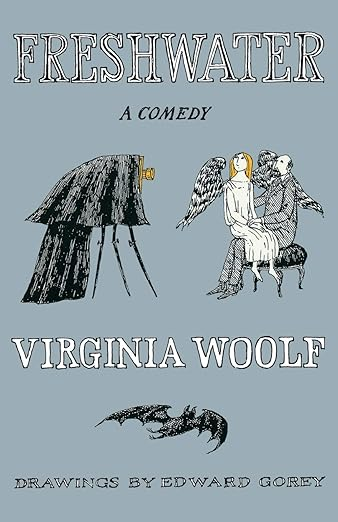
“The play came off last night, with the result that I am dry-brained this morning, & can only use this book as a pillow. It was said, inevitably, to be a great success.’
Virginia Woolf,
Diary IV, 19th January, 1935
In 2026 we mark the centenary of the period when Woolf began to immerse herself in life writing. Having tested her new narrative form in Jacob’s Room (1922) and moved on to the more successful Mrs Dalloway (1925), she began to consider how her work might overlap with the genre of the elegy, a phase of experimentation that culminated in the fictionalisation of her parents in To the Lighthouse (1927). This was followed by the brisk and daring Orlando (1928) a work that deliberately ripped at the seams of the biographical form. Having explored the limits of the gendered, human life, she then progressed to Flush (1933), a sensitive portrayal of canine existence that roots itself in the non-human world. This humorous and occasionally dark portrayal of Elizabeth Barrett Browning’s dog inverts a hierarchy of importance where famous poets are purportedly more important than their pets.
Woolf continued in this irreverent vein by completing her only play, Freshwater, in 1935. This work was designed to be performed for and by her immediate family, and revels in satirising her maternal ancestors and all of their famous friends. Throughout the play, Woolf affectionately thumbs her nose at the previous generation while also exploring how attitudes towards creativity and artistic endeavour may have shifted in the intervening years.
Toby and Karina will guide attendees through these two works, moving through Flush first. There will also be opportunities to consider the life and work of Elizabeth Barrett Browning and a selection of her poems will be provided for this purpose. We will then have our own performance of Freshwater with time to discuss Woolf’s interest in family history and her preoccupation with plays and playwriting. Reading these texts side by side will encourage us to consider Woolf’s views of the 19th century, her interest in the non-human and natural world, and her unique sense of humour. Woolf is not often regarded as a comedic writer, but these two works prove she had a wonderful eye for the bathetic and the absurd.
JOINING DETAILS:
- To ask questions please email us at litsalon@gmail.com using ‘Flush & Freshwater 2026’ as the subject line. To reserve a place please use the form below to pay an initial deposit of £50. Full payment may be made later by bank transfer.
- Four-day in-person study facilitated by Toby Brothers and Karina Jakubowicz
- Thursday 9 – Sunday 12 April 2026, Alfriston, East Sussex
- This is an opportunity to enjoy the locale, including visiting Charleston House, Charleston in Lewes and Monk’s House, as well as joining with other readers in discussing Between the Acts and its relationship to Woolf’s other works. We will also research outings in the area based on exhibits that will be available at the time of our visit, these will be added to the schedule as we confirm the best options.
- As in previous years, we are in conversation with our fellow enthusiasts at Much Ado Books in Alfriston, who have created a great community that celebrates reading and the art of books in wonderful ways. Together we will offer an event celebrating Woolf, Flush and Freshwater during our stay there.
- £500 for twelve hours (or more) of study in six meetings spread over four days, plus accommodation costs (please see details below).
- Please note that participants are responsible for booking their own travel, accommodation and any insurance required.
- We will stay at Wingrove House, a 19th century colonial-style country house hotel set in the beautiful and historic village of Alfriston, East Sussex in the South Downs National Park. We will be within easy reach of sites associated with Bloomsbury, making it the ideal choice for Woolf-related Salons. We expect the cost per night, including breakfast, to start at £206.00 per room, rising to a maximum of £244.50 (charges vary across a range of accommodation). These rates are discounted for London Literary Salon participants, so please reserve your room as soon as possible after registering your place on the study and mention the London Literary Salon when booking.
- Recommended editions: Flush by Virginia Woolf, Oxford World’s Classics ISBN-13: 978-0199539291; Freshwater: A Comedy, Houghton Mifflin ISBN-13: 978-0156335409