The Aeneid on the Greek island of Agistri
Event Details
We are currently planning our fifth visit to the enchanting island of Agistri on the Saronic Gulf to read the classical literature of Greece and Rome. In 2026 we will study Homer’s Odyssey and Virgil’s Aeneid, reading these extraordinary and enduring works in the midst of a land and seascape that can only enhance the experience. Check out our ‘Gallery’ page to see photos from our 2025 studies on the island.
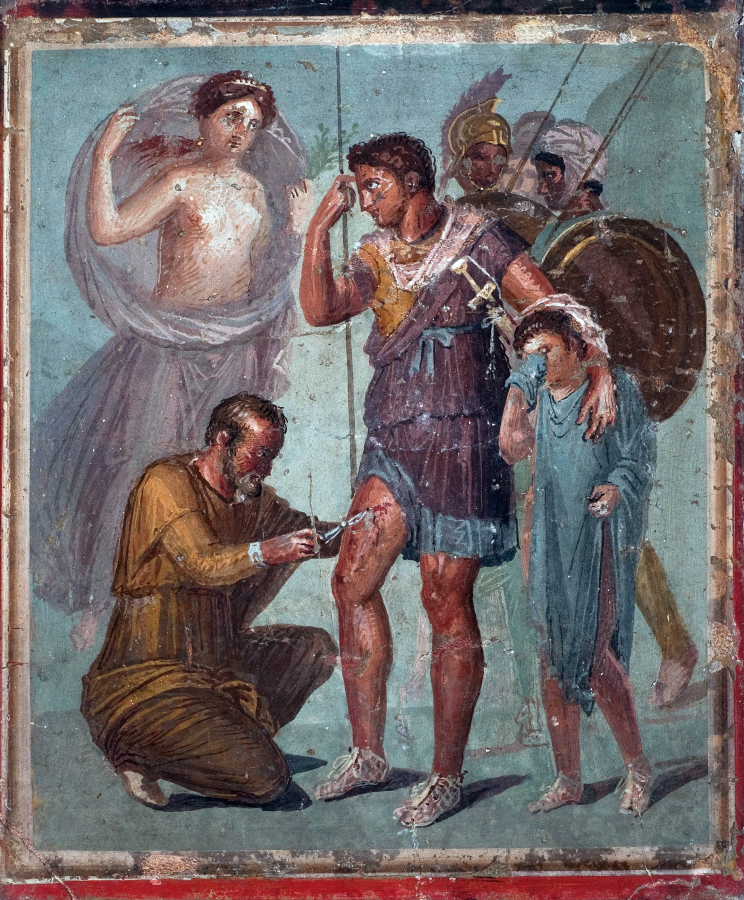
The warrior Aeneas fell to his knees but kept himself propped up with one hand firmly on the ground. Black night covered his eyes. Aeneas, lord of men would certainly have died right then and there, had not his mother Aphrodite noticed. She threw her white arms around him and embraced him and wrapped him up inside her glimmering dress to keep him safe from weapons, so no Greek would gallop up and hurl a spear of bronze to pierce his chest and take his life away. She took her darling son away from battle.
Iliad, Book 5
As with the Odyssey, the Oresteia and Euripides’ Trojan Women, the story of the Aeneid starts with the fall of Troy and its aftermath. However, unlike these earlier works, the Aeneid – written between 30 and 19 BC – belongs to a different language and to the Roman Empire. Escaping the burning city, Aeneas travels across the Mediterranean and ultimately to Italy, where his descendants will go on to found the city of Rome. In continuing the story of Aeneas, Virgil created a foundational myth so profound and enduring that when Dante wrote his Divine Comedy, he chose the poet to be his first guide to the afterlife.
The opening books of the poem contain the full story that Homer did not give us: the clanging of the Greek warriors inside the wooden horse, the anger of the decimated Trojans turned against Helen as the city collapses around them, the vision of Aeneus – son of Venus – leading his own son by the hand and carrying his father on his back as he flees.
In the figure of Aeneas, we find both the survivor of a city lost to war and the leader of a colonising force, prompting us to ask questions about identity and nationhood that continue to resonate in our own time. How do we justify the indifference of power? How can we guarantee that force is used responsibly? Virgil shows us how fine is the line between mastery and brutality. The Aeneid is a masterpiece of epic poetry, full of beautiful language that transports us to the world of the Aegean and beyond.
JOINING DETAILS:
- Seven-day study of Virgil’s Aeneid on the island of Agistri: 30 April – 7 May 2026
- Facilitated by Toby Brothers, Caroline Hammond and Jane Wymark
- Cost: £880 for the Salon study, to include a preparatory meeting in April (on Zoom, date to be confirmed), background materials and opening notes. Opening notes will be sent after registration.
- The study programme will run for four to five hours per day for five days, with one day left open and travel at each end. There will be time for other optional activities including kayaking adventures, a trip to the Temple of Aphaia on Aegina, or pure relaxation.
- Before you arrive on Agistri we will ask you to read The Aeneid, translated by Robert Fagles, Penguin Books, ISBN: 9780143105138.
- Payment: we ask for an initial (non-returnable) deposit of £50 on registration to secure your place using the booking form below. The balance of £830 will be payable by bank transfer (we will supply bank details), due by 31 January 2026.
- Refunds: please note that any refunds will be entirely at the discretion of the London Literary Salon, dependent on our ability to fill the place, and will be subject to a charge to cover our administration costs.
- Waiting list: if the study sells out early we will maintain a waiting list as we sometimes find that people have to withdraw for reasons beyond their control.
BOOKING & ENQUIRIES
To ask questions please email us at litsalon@gmail.com using ‘Agistri 2026 – Odyssey’ as the subject line.
ADDITIONAL COSTS TO BUDGET FOR
Room and half board (breakfast and dinner each day) will be arranged by each participant with the hotel and paid for directly to them. A deposit to cover two nights accommodation will be required by the hotel on booking. We will send you full contact details for payment on registration. We have set out the anticipated charges below, but these may be subject to change at the time of booking at the discretion of the hotel.
Accommodation prices per night at the hotel – Rosy’s Little Village – are estimated below on the basis of figures available in July 2025 but may be subect to change:
- Single – €80 per night plus half board (breakfast and dinner) estimated at €55 per day
- Double – €90 per night plus half board (breakfast and dinner) estimated at €55 per person per day
- Triple – €77 per night plus half board (breakfast and dinner) estimated at €55 per person per day
- Family room for two people – €100 per night plus half board (breakfast and dinner) estimated at €55 per person per day
- Family room for three people – €107 per night plus half board (breakfast and dinner) estimated at €55 per person per day
Please consider sharing accommodation with another participant as this helps us to ensure everyone can stay on site; double and triple rooms offer split levels and so allow sharers a significant degree of privacy.
Flights to Athens: when booking please make sure you can arrive in Piraeus by 15.00 local time on the first day of your study to catch the ferry. We will not be meeting formally on the final day of each study, so you have choices about your return (ferries are frequent and the travel time to Piraeus is one hour).
Ferry to Agistri: normally around €14 each way, but may be €30 for arrival if the group chooses to use a private water taxi.
Incidental expenses: drinks, lunches, extra trips etc.
Insurance: we hope this will be entirely redundant, but we ask you to arrange your own travel and health insurance to protect you in case of anything untoward happening. We will ask you for details of the insurance provider and reference number, as well as your mobile phone number and details of next of kin to add to our (confidential) records for use during the study.